G-Wallac-E
A GTK4/libadwaita desktop app that runs G#, a pure-functional geometric DSL where programs construct points, lines, circles, and arcs through intersections and measures — no raw coordinates.
Project Overview
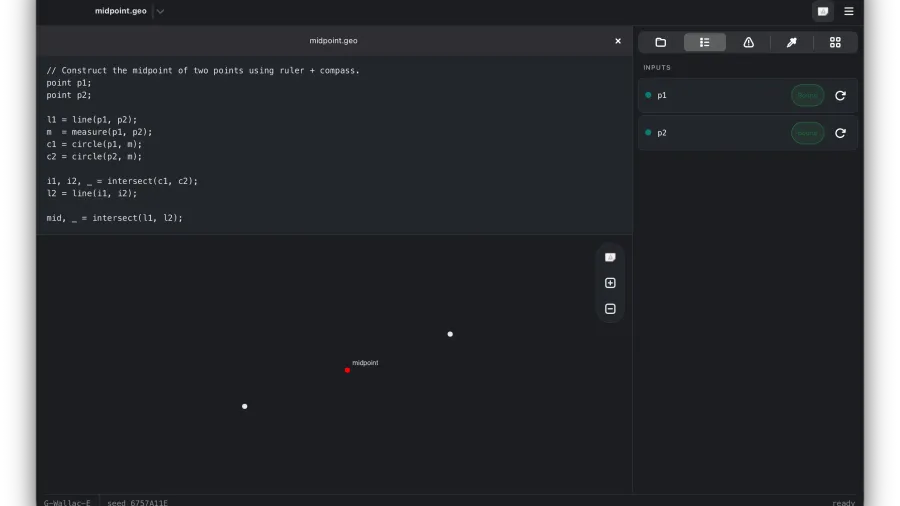
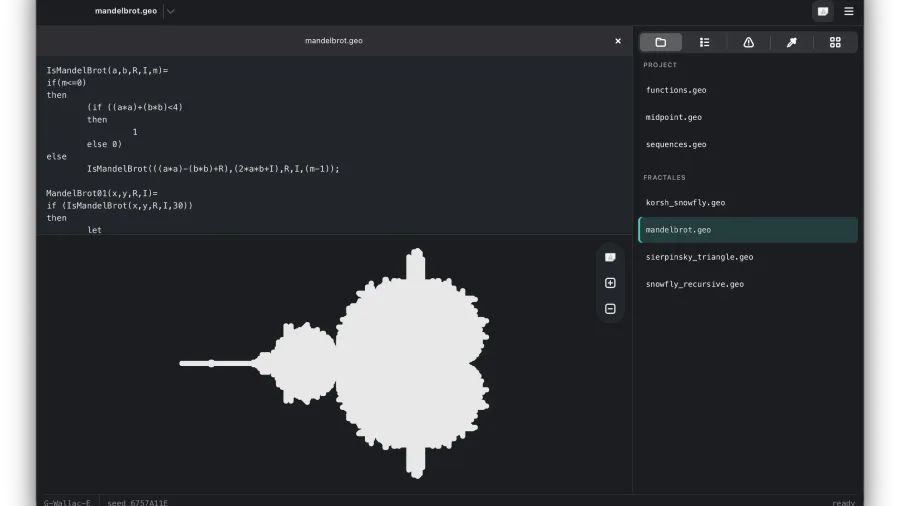
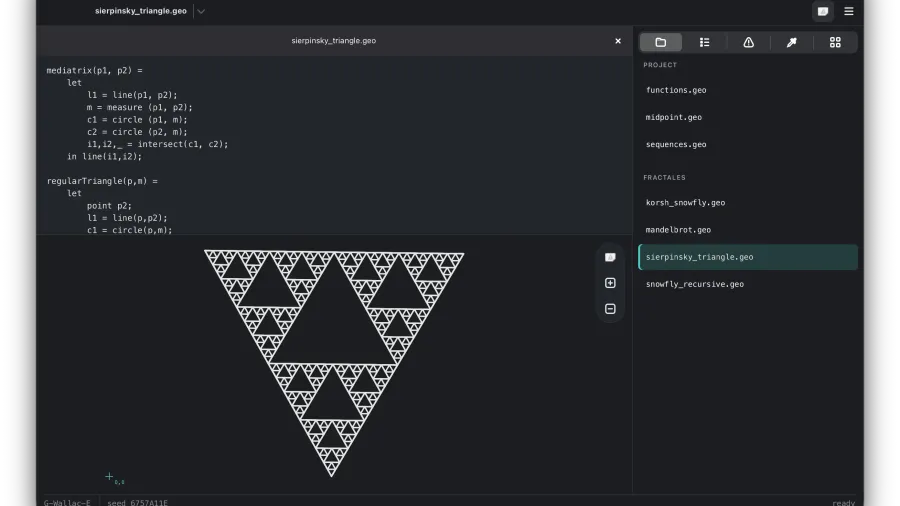
G-Wallac-E is a native desktop application that brings ruler-and-compass geometry to life through a custom programming language. The app hosts the G# interpreter — a pure-functional DSL with Hindley-Milner type inference — and renders every construction live on a Cairo canvas as you write.
What makes it interesting is the constraint: coordinates are completely hidden from the programmer. Every geometric object is declared through constructors, intersections, and measures, mirroring how classical geometric proofs work. The result is a tight feedback loop between writing a program and watching a proof materialize on screen.
The Problem It Solves
Classical geometry education tools either hide the math behind GUIs or expose raw coordinates that break the ruler-and-compass abstraction. G# occupies the middle ground: it’s a real programming language with types and lazy sequences, but its semantics enforce the constraint that you can only construct what is geometrically constructible.
// Perpendicular bisector of two free points
point p1;
point p2;

l1 = line(p1, p2);
m  = measure(p1, p2);
c1 = circle(p1, m);  c2 = circle(p2, m);

i1, i2, _ = intersect(c1, c2);
l2        = line(i1, i2);
mid, _    = intersect(l1, l2);

draw {p1, p2};
red color;
draw mid "midpoint";
restore;
The program above computes the midpoint of two draggable points with no coordinates in sight.
Key Features
- G# Language: Pure-functional DSL with HM type inference and lazy sequences
- Live Canvas: Cairo-rendered canvas updates instantly as code changes
- Free Inputs: Declare
point p;and drag it on canvas — all dependent geometry recomputes - Geometric Primitives: Points, lines, circles, arcs, and their intersections as first-class values
- Color & Labels:
drawcommands support color modifiers and string labels for annotations - Layered Architecture: UI, renderer, runtime, type checker, parser, and geometry are strict top-down layers
- Testable Core:
Engineinterface lets the interpreter run in test suites without any GTK dependency - Blueprint UI: Editor, canvas, and inspector panels built with libadwaita and Blueprint
Technologies Used
- Language: C++23
- GUI Toolkit: gtkmm-4.0 + libadwaita ≥ 1.4
- UI Description: Blueprint (GTK UI markup)
- Rendering: Cairo
- Build System: Meson ≥ 1.3 + just
- Compiler: clang/clang++ ≥ 17
- Architecture: Six-layer stack (ui → render → runtime → sema → syntax → geom)
Architecture
The interpreter is split into six layers with a strict top-down call discipline:
| Layer | Role |
|---|---|
ui/ |
gtkmm4 + libadwaita + Blueprint — editor, canvas, inspector |
render/ |
Cairo painters that convert DrawList to pixels |
runtime/ |
Evaluator, Value type, lazy Sequence, Env |
sema/ |
Resolver and HM type checker |
syntax/ |
Lexer → Parser → AST + diagnostics |
geom/ |
Primitives, constructors, intersection math |
The Engine class (src/engine.h) is the only seam between the GTK frontend and the language stack, keeping the interpreter fully testable in isolation.
Getting Started
# Clone and enter
git clone https://github.com/ARKye03/g-wallac-e.git
cd g-wallac-e

# First-time setup (configures meson with clang toolchain)
just setup

# Build and run
just

# Run test suite
just test
macOS prerequisites: brew install gtkmm4 libadwaita just llvm
Results
- A fully working geometric construction environment driven entirely by a custom language
- Clean language/UI separation enabling unit tests with no GTK dependency
- HM type inference catches geometric type errors (e.g., passing a circle where a line is expected) at compile time
- Lazy sequences allow infinite geometric constructions without eager evaluation overhead
- Example programs covering classic constructions (midpoint, bisector, inscribed circle) ship in
tests/samples/